Cat years to human years: how to calculate your cat's age


Enter a keyword below to search for articles and products.
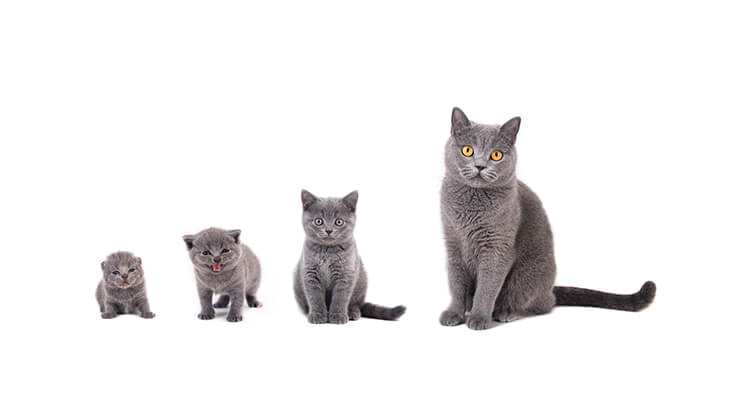

To calculate your cat’s age in human years, use the 15-9-4 rule. A cat's first year is 15 human years. The second year adds 9 years, and each following year adds 4 years.
Cats develop especially quickly in their first year, so after one human year they are already the equivalent of a teenager.
It’s difficult to answer how many cat years is one human year, as the conversion isn’t quite as simple as that.
Though there is a common misconception that one human year is equal to seven cat years, a rough guideline to work out cat years to human years is the 15-9-4 formula.
This formula suggests that in your cat’s first human year of life, when they are developing at an incredible rate, they actually age 15 cat years. The year after, they are still developing quickly, just not as much as they were in kittenhood, so they are actually 24 cat years old after two human years of life.
At this point, they have reached full maturity, and development slows down. That’s why, after the second year, each human year is consistently equal to four cat years.
Cats are born to grow up and reproduce in just one or two years to survive in the wild. This fast biological clock means they are considered elderly in around 15 years instead of our 80 or so.
This is why cat age in human years is worked out the way it is, as cats have a shorter life expectancy and develop at a far different rate to humans and even at a different rate depending on their own stage of life.
To make converting cat years to human years less complicated we have put together this handy cat age chart so you can easily work out your cat's equivalent age.
For example: A 3-year-old cat is approximately 28 in human years, calculated by adding 15 for the first year, 9 for the second, and 4 for each subsequent year.
Life stage | Age of cat | Human equivalent age |
Kitten (Birth – 6 months) | 0–1 months | 0–1 years |
2 months | 2 years | |
3 months | 4 years | |
4 months | 6 years | |
5 months | 8 years | |
6 months | 10 years | |
Junior (7 months – 2 years) | 7 months | 12 years |
12 months | 15 years | |
18 months | 21 years | |
2 years | 24 years | |
Adult (3 – 6 years) | 3 years | 28 years |
4 years | 32 years | |
5 years | 36 years | |
6 years | 40 years | |
Mature (7 – 10 years) | 7 years | 44 years |
8 years | 48 years | |
9 years | 52 years | |
10 years | 56 years | |
Senior (11 – 14 years) | 11 years | 60 years |
12 years | 64 years | |
13 years | 68 years | |
14 years | 72 years | |
Super Senior (15 years +) | 15 years | 76 years |
16 years | 80 years | |
17 years | 84 years | |
18 years | 88 years | |
19 years | 92 years | |
20 years | 96 years | |
21 years | 100 years |
The chart works well if you know your cat's birthday, but if you've adopted or rehomed a cat with no history, here's how to estimate their age instead.
If you have rehomed or adopted your cat from a shelter you may not know their exact age. In these cases, owners can use various physical and behavioural cues to help determine their cat's approximate age.
While teeth can provide insights into a cat's age, it is important to note that cats can have oral health issues for a variety of reasons, and it isn't an exact science.
A cat’s eyes can be another indicator of their true age as they generally become cloudier and change in appearance in their senior years. Here are the key signs to look for.
Check your cat’s coat! The condition of a cat’s coat can give us more clues about their true age. Cats are well known for grooming themselves and keeping their coat clean. In senior years they slow down and maybe not groom themselves as efficiently as they did, so initiating a regular grooming session using coat appropriate brushes will be well received by most cats. Dry coats may also tangle faster and need more care, make sure to keep up with a good grooming routine with older cats.
Last but not least, muscle mass and bone density can also give us a better idea of what age a cat is. Look at how their bodies fill out and how many bones you can see protruding. Middle-aged cats are known for putting on some pounds, but older cats are more likely to lose weight. This is due to older cats eating less and absorbing nutrients differently, we advise a change in diet to a complete and balanced food, tailored to meet the nutritional requirements of senior cats.
Once you understand your cat’s age, even if it is just an estimation, you will be more prepared for any age-related health issues that may arise.
This means you’ll be better equipped to deal with adjusting food, arranging more frequent vet check-ups, and adapting to changing activity levels.
It will also mean you understand any changes in behaviour better and are more able to care for your cat as it gets older.
The average life expectancy of a cat can vary based on many factors including the breed, their lifestyle (indoor or outdoor), and the pet’s overall health.
Indoor cats: Typically live longer and have an average lifespan of 12 to 15 years. Many indoor cats reach their late teens and even early twenties!
Outdoor cats: Generally have shorter lifespans due to risks like traffic accidents, predation, disease, and harsh weather conditions. Outdoor cats’ life spans average around 5 to 7 years.
Like most animals, genetically diverse (mixed-breed) cats are usually less likely to have inherent health risks than pure-bred cats. A loved and well cared for cat is more likely to have a longer lifespan. Vaccinations, routine parasite prevention, oral care routine, grooming, attention and interaction are key to a happy and healthy cat. A complete and well-balanced diet, tailored to their life-stage and lifestyle, alongside a good sleep routine can also improve the health of your cat in the long run!
A cat reaches maturity after two human years of development. This is why the 15-9-4 rule for converting human years to cat years suggests a cat is 24 cat years old after just two human years.
After about one to two years a kitten will have reached full size and transition from kittenhood into adulthood.
Cats are considered senior cats between the ages of 7 and 11 human years. An 11-year-old cat would be considered 60 years old in cat years. Whiskas recommends feeding your cat senior food from age 7.
*Based on PRS In-Vivo study (2024) on quality and enjoyment perceptions of 200 cat owners (UK)

Subscribe to our newsletter to receive a welcome discount, useful tips and exciting news about our products.
Discount code valid until 31.12.2026 on a purchase of WHISKAS® products on www.zooplus.co.uk. Zooplus minimum order £10, code cannot be used in conjunction with other offers or discounts. Code valid for one time use.


Click to buy from any of the retailers below